Spinal Reflexology
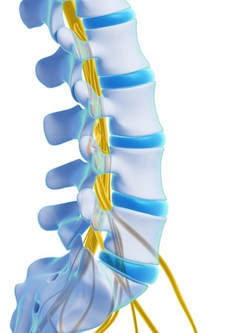
Back pain affects around three quarters of adults at some point in their life. The simplest of tasks, such as reaching for something or picking up a child, can muscle spasm and pain. Muscle spasms put pressure on the spinal nerve routes. This in turn can create pain, alter posture and worsen the muscle spasm and cause a cyclical problem. In addition, compression of spinal nerve routes can affect the nerve impulses to its organ or body part.
Compression of a spinal nerve route can cause interference in the nerve pathway. This can cause the organ(s) or parts of the body that the pathway serves not to function properly. Causes of compression are various and can include injury, poor posture, infections and spinal disorders, such as scoliosis.
Referred pain occurs because some parts of the body are served by the same nerve routes, in these cases the nerve impulses that reach the brain from one area may be misinterpreted as coming from another. Examples of this include pain in the foot or leg due to compression of the spinal nerves due to a disc prolapse, lower backache can be referred pain from menstruation, and whiplash can cause pain in the wrist.
The theory behind spinal reflexology:
Case Studies
Case studies from L Keet, 2017, Principal of the London School of Reflexology
Compression of a spinal nerve route can cause interference in the nerve pathway. This can cause the organ(s) or parts of the body that the pathway serves not to function properly. Causes of compression are various and can include injury, poor posture, infections and spinal disorders, such as scoliosis.
Referred pain occurs because some parts of the body are served by the same nerve routes, in these cases the nerve impulses that reach the brain from one area may be misinterpreted as coming from another. Examples of this include pain in the foot or leg due to compression of the spinal nerves due to a disc prolapse, lower backache can be referred pain from menstruation, and whiplash can cause pain in the wrist.
The theory behind spinal reflexology:
- if organs are not functioning properly then it can affect the spinal nerve route and produce pain in the spinal reflex
- in cases of back pain and spasm, the specific vertebra that is causing the problem can often be identified
Case Studies
- A professional dietician was suffering from digestive problems. During spinal reflexology, scoliosis (a sideways curve of the spine), was identified which appeared to be causing compression on Lumbar vertebrae 1. Using spinal reflexology on L1 and the intestines, the part of the body that L1 serves, there was a real difference to her ISB and her life. Additionally, her absorption of nutrients increased and she became pregnant. The client put this down to reflexology.
- A client had suffered a back injury in a car accident. Shortly afterwards, he started experiencing depression for the first time in his life. By using spinal reflexology, it was found that there was compression in T9, this serves the adrenal gland. By using reflexology techniques on the gland and T9 the depression lifted.
- A 26 year old woman who had a history of miscarriages wanted to become pregnant. She had no aches and pains and a healthy. During treatment, spinal nerve route L3 was found to be sensitive, and discussion showed that 7 years prior she had had a riding accident. Treatment focused on L3, the route for uterus and ovaries, related reflexes and balancing the hormone system. The approach worked and she became pregnant.
Case studies from L Keet, 2017, Principal of the London School of Reflexology